Table of Contents
Recycled material is a secondary raw material obtained through the recycling of waste, which is finding increasingly wide application in modern production. It plays a key role in the circular economy (CE), allowing for the conservation of natural resources and a reduction in waste. In this article, we will explain what recycled material is precisely, what properties it has, and how it differs from regranulate.
What is recycled material? Definition and basic concept
Recycled material is a material obtained from processed waste (such as the PET bottles well known to all of us) that is used to manufacture new products. Basically, it is no black magic, but simply a brilliant way to give old plastic or paper a completely new lease of life. EU regulations, including EUR-Lex guidelines, clearly state that such a raw material must be created through a recovery and treatment process. We have the feeling that it is precisely the simplest solutions that can make the biggest difference in our daily approach to production.
Where does this material actually come from, and why don’t we just throw everything into one bag? You can probably guess that from a general waste bin full of food scraps and peelings, you cannot magically conjure up clean plastic. According to data published by the OECD, the quality of recovery depends mainly on selective collection systems. For full-fledged recycled material to be created, waste must come from homogeneous fractions. In other words – source separation is an absolute foundation without which modern factories would have nothing to work with.

Where does recycled material come from, and why do homogeneous fractions do all the work?
Wondering where these raw materials actually come from? We have two main sources here. The first is post-consumer waste – meaning everything that we ourselves throw into yellow or blue containers (from the aforementioned PET bottles and foil to various types of packaging). The second source is industrial waste, which includes clean offcuts or defective batches from factories that did not even manage to reach stores. As industry experts point out, the key to success here is the homogeneity of the waste stream.
Why can’t we throw everything into one mixed waste bin? Here are a few reasons why sorting matters:
- Different types of plastics: Plastic is not just plastic – combining polyethylene and polypropylene in a single melting process would result in a useless, weak mass.
- Contamination: Food scraps, labels, or adhesives effectively lower the quality of the final product.
- Purity requirement: Modern sorting technologies can extract up to 98% material purity from homogeneous fractions.
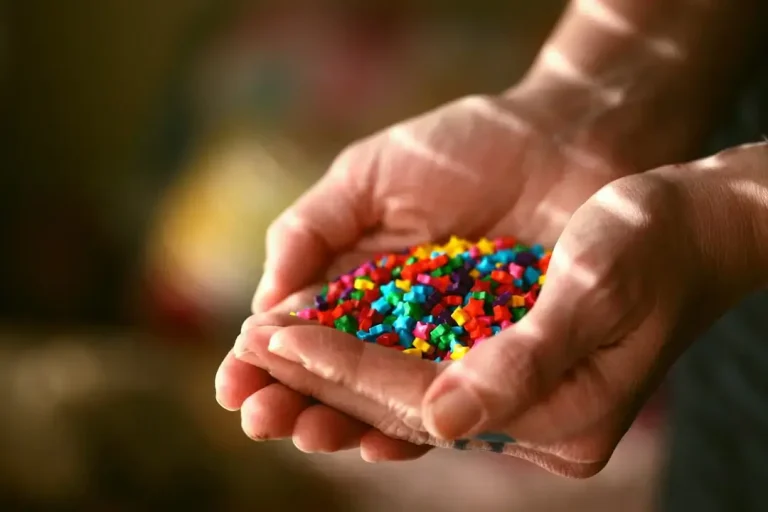
- Repeatability: Without clean streams, it is impossible to create regranulate, which is an ideally homogeneous, granulated form of recycled material ready for industry.
By the way, thanks to advanced washing, shredding, and granulation methods, such recovered raw material can boldly compete with virgin materials. And that means less plastic in the environment and a lot of joy from a job well done!
Why does recycled material matter for sustainable development?
Do you ever wonder what happens to all that plastic we throw into the colorful containers? Well, the heart of the modern circular economy is now becoming the raw material that gets a second life. Instead of thoughtlessly drawing from nature, we are increasingly and boldly reaching for what has already been produced. And, although traditional raw materials can sometimes be cheaper at the start, choosing secondary alternatives is no longer just a whim, but becomes a market necessity. As analysts citing OECD data point out, without changes in the approach to production, the amount of plastics could drastically increase in the coming decades, making every ton of recovered material a real relief for our planet.
We are entering a moment where manufacturers face a major dilemma. On the one hand, we have convenient virgin raw material; on the other, pressure from EU regulations, such as the PPWR regulation supervising the packaging market, which is loudly discussed by EU’s EUR-Lex. These regulations set clear requirements for the minimum share of recycled materials in new products. Does it pay off? Of course it does, although it requires flexibility and smart supply chain management from companies. Besides, we get the impression that customers are also increasingly demanding transparency, asking directly about the carbon footprint and origin of the things they buy.
Key ecological and business benefits of using recycled materials
Seriously, the advantages of using secondary raw materials go far beyond simply being “in harmony with nature.” When we look at it closely, we see a whole list of measurable benefits – both for the environment and for the brand’s wallet:
- Conservation of non-renewable resources: Less oil, gas, or metal ore extracted from the earth means less pressure on ecosystems, as confirmed by UNEP reports, among others.
- Less waste in landfills: Giving a second life to raw materials effectively reduces the mountains of garbage lingering in dumpsites.
- Reduction of CO2 emissions: Processing recovered materials often consumes less energy than producing them from scratch, which lowers our shared carbon footprint.
- Strengthening brand image: Customers are looking for responsible brands. Transparent communication based on facts and certificates builds trust, as business analyses in Money.pl frequently remind us.
- Regulatory security: Meeting EU standards regarding recycled material allows for avoiding future fines and ensures the brand a stable position in the market of the future.
And although expensive chemical recycling or complex post-consumer waste (PCR) sorting can sometimes give production engineers a headache – as mentioned by the industry portal Dla Produkcji – the direction is singular. Using recycled materials is simply a smart investment in tomorrow, allowing companies to play in the premier league of responsible business.
Key properties and components of recycled materials
Do you ever wonder what is going on with these recovery plastics? Seriously, the secondary polymer loop can surprise you. As European Commission data indicates, mechanical recycling is still developing, yet materials like PE or ABS usually have slightly lower mechanical strength and quality compared to virgin raw materials. We want to create durable things, after all, right? Therefore, it is worth taking a close look at what actually ends up in our production machines.
We have the impression that recycled materials are a bit like home cooking from leftover fridge ingredients. The result depends on what happens to fall into the container! According to analyses by processing experts from Dopak, closed-loop plastics are rarely a homogeneous substance. They are rather a variable mixture of the main polymer, residual additives, colorants, and minor contaminants. Sometimes, moisture also stands in the way of an ideal form – for example in the case of PET, which is accurately described by the guidelines of the PN-EN 18064 standard, requiring us to be particularly vigilant and to thoroughly dry the granulate before starting injection molding.

Physical and mechanical characteristics of circular economy materials
So what makes the behavior of recycled materials on the production line so fascinating? First of all, their unique thermal history. Each successive melting and grinding cycle acts on the polymer like regularly shortening a string – you end up with a shorter form, which naturally affects the parameters of the entire batch. After all, a cut string is still a string, but will it hold the same weight? We probably know the answer.
To make it easier for you to grasp all these nuances, we have gathered the most important physical and mechanical features of recycled materials into a few clear points:
- Variable polymer chain length: Repeated processing means that the material may exhibit greater brittleness, lower impact resistance, and weaker tensile strength.
- Different melt viscosity: Recycled materials often flow through the mold a bit easier (following the analogy, water travels through a narrow corridor faster than thick honey), which can speed up the cycle, but also carries the risk of unstable filling of the mold cavities.
- Fickle dimensional stability and color: The secondary loop favors the formation of streaks, slight yellowing, or variable shrinkage, which is why quality control of batches is so important – for example in accordance with the standards for polyethylene described in PN-EN 18064-2.
- Susceptibility to modification: Seriously, we are not helpless! By adding appropriate stabilizers, plasticizers, or mixing the recycled material with virgin raw material (a bit like sewing a stronger patch onto your favorite trousers), we can fully control the final properties of the product.
Application of recycled materials in economic practice
Can an old beverage bottle or a worn-out wheel rim gain a completely new life? Seriously, absolutely! Waste processing has long ceased to be treated solely as a nice-looking gesture. Today, it is a powerful driving force for the modern economy, which has permanently established itself in large factories and smaller production plants. Besides, we get the impression that secondary raw materials have ceased to be a backup plan and have simply become the material of choice for engineers. According to reports by opakowanie.pl, EU regulations already mandate the use of a minimum share of recycled materials in PET bottles, and in the coming years, these requirements will cover an even wider range of plastic packaging.
Where will you most often encounter secondary raw materials in daily life and industry?
Let’s face it – recycled materials surround us on all sides, even if we rarely think about it over our morning coffee. The most important sectors where recovered raw materials play a leading role include:
- Packaging and FMCG industry: According to information published by tworzywa.online, the food giant Mondelez International took a bold step and implemented innovative packaging for the popular Marabou chocolate bars. They utilized CirculenRevive polymers supplied by LyondellBasell, thanks to which the finished packaging contains as much as 75% attributed recycled material. Furthermore, protective films, polyester straps, or disposable items are increasingly made from regranulates.
- Automotive: As reported by tworzywa.pl and aseosystem.pl, the Ford concern boldly reaches for recycled materials in the production of vehicle interior components, achieving quality parameters that do not yield to virgin raw materials. PP and HDPE regranulates go into dashboards, interior panels, bumpers, mirror housings, or fluid tanks. Meanwhile, as toyotanews.eu informs, Toyota’s British branch at the Burnaston factory recovers aluminum from spent wheel rims, processes it, and feeds it directly into the production of engine components for the hybrid Corolla. Closed-loop systems in their purest form!
- Industrial and technical chemistry: Hard structural plastics recovered in chemical recycling processes (such as PET glycolysis or polyolefin pyrolysis described on tworzywa.pl) return to circulation in places where reliability and chemical purity are an absolute priority.
You will surely admit that the scale of these changes is impressive. Of course, as plastics industry specialists note, acquiring a clean and repeatable input raw material remains a challenge, and chemical recycling can sometimes cost two to three times more than traditional production. Despite this, the determination of manufacturers and growing awareness mean that the train named “circular economy” will no longer be stopped by anyone. And very well so!
Frequently Asked Questions (FAQ)
What is the difference between recycled material and regranulate?
Recycled material is a general term for any material obtained through the recycling process. Regranulate is a more processed, homogeneous form of recycled material. It possesses better and more predictable technical properties, making it suitable for more demanding production applications.
Who uses recycled material in their operations?
Recycled material is primarily used by:
- Manufacturers of packaging, films, and securing straps,
- Companies striving to achieve corporate social responsibility (CSR) goals,
- Enterprises looking for real savings and ecological alternatives to virgin raw materials.
What is the opposite of recycled material?
The opposite of recycled material is primary material (also known as virgin material). This is plastic obtained directly from natural sources – in the case of plastic, this is crude oil – which has not undergone any recycling process previously.