Table of Contents
When buying honey, you want to be sure you are benefiting from its natural antibiotic and immune-boosting properties, not consuming sugar syrup. Identifying an authentic product without a laboratory visit is possible thanks to a few simple home tests. In this guide, we will walk you through the honey verification process step-by-step so you can enjoy only a true gift of nature.
Preparing for Honey Verification
Before we start playing home laboratory, let’s establish one thing: honey is a true gift of nature, provided no one has tampered with it. A real bee product is made exclusively from flower nectar or honeydew. Nothing more! No sugar syrup, dyes, or other “enhancers” that sometimes try to mimic the original. We feel that in the age of mass production, it’s worth taking a moment to check what ends up in our tea.

By the way, honey testing isn’t some secret knowledge available only to chemists. It’s more of a cool experiment you can do together with the kids in the kitchen. Seriously, all you need is a few items you probably have on hand anyway. You don’t need specialized equipment to see if the product you’ve chosen is “liquid gold” or just a sweet mixture from a factory.
What will you need?
Prepare a small research station on your countertop. To carry out the tests efficiently and without stress, pull the following items from your cupboards:
- Honey sample – just a jar that piques your curiosity (or suspicion).
- A glass of cold water – ideal for the solubility test.
- A spoon – for scooping and pouring honey (we recommend the classic metal one).
- A small plate – useful for the so-called honey memory test.
- Indelible pencil – an old, reliable way to check moisture and the presence of sugar.
Did you know that home methods, though simple, can be surprisingly effective? According to drmedicus.pl, natural honey always behaves in a specific way, e.g., flowing in a steady stream and forming a cone on the surface. Ready for the tests? Well, let’s get started; there’s no reason to wait!
Step-by-Step Instructions: How to Check Honey Authenticity
Buying honey is sometimes a bit of a lottery, especially when standing in front of shelves overflowing with jars at the supermarket. We too have often wondered if this beautiful, golden liquid is actually the work of bees or perhaps the result of efficient chemists’ work. Fortunately, you don’t need a lab to verify it. Your kitchen, a moment of patience, and a few simple tricks that immediately expose “fakes” are enough. By the way, real honey has such an intense aroma that you will often feel the difference just by the smell – natural honey smells like a meadow, not just sugar.
Step 1: Water Dissolution Test
This is our favorite method because it gives a result almost immediately. Real honey is quite “stubborn” and doesn’t want to make friends with water quickly. How to check it?
- Fill a glass with cold water.
- Scoop some honey onto a spoon and slowly pour it into the vessel.
- Observe how it behaves.
A natural product will sink to the bottom, forming distinct streaks and lumps, and the mixing process will take you a long time. If the honey dissolves instantly, like fruit syrup, it’s a sign that you are dealing with an artificial product. As reported by Agape, natural honey dissolves unevenly, which is its characteristic feature resulting from its density.
Step 2: Flow Test (Pouring)
This test only requires a steady hand and a bit of focus. Seriously, it’s the easiest method to check consistency. Observe the honey stream very carefully – this is where the whole truth about its quality lies.
- Lift a spoonful of honey high above a plate or a jar.
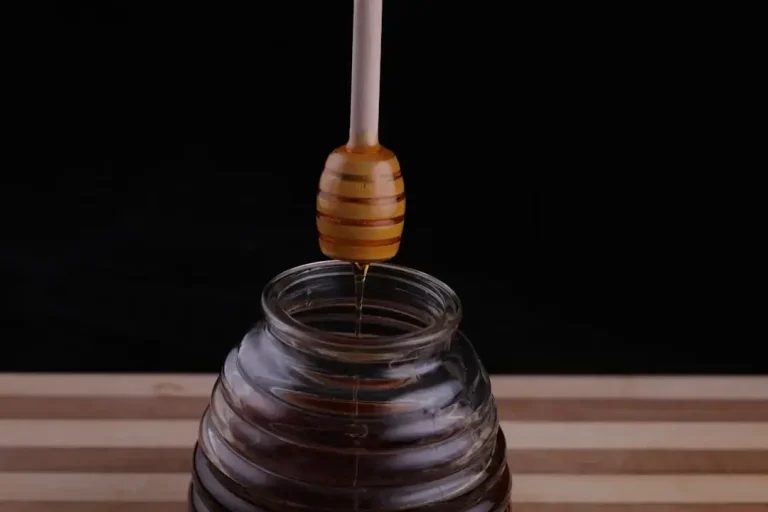
- Let it flow freely in a continuous stream.
- Look at the spot where the honey hits the surface.
There is perhaps nothing more satisfying than the sight of honey that forms a clear cone on the surface (the so-called mound). Real nectar flows uniformly, does not break, and that small pyramid at the bottom lasts for a while before leveling out. Artificial honey will simply soak into the rest of the mass, creating a depression or a perfectly flat surface immediately upon contact.
Step 3: Crystallization Verification
We have a feeling this is the most controversial point for many people, because crystallization is often associated with “spoiling.” Nothing could be further from the truth! It is an absolutely natural process that should make us happy. If your honey remains crystal clear and runny even months after purchase (with a few exceptions, like acacia honey), a red light should go off in your head.
- Check the consistency a few weeks after opening – the honey should eventually become hard and grainy.
- Note the bottling date – most Polish honeys will crystallize before winter.
- Remember that artificial honey will never change its state of matter because it lacks the pollen and natural enzymes that initiate this process.
It’s no shame to have “sugar” in the jar – it’s simply proof that the bees worked hard!
Common Mistakes when Buying and Evaluating Honey
Buying honey seems simple until you’re standing in front of a store shelf packed with rows of golden jars. As natural product enthusiasts, we often see how easy it is to be fooled by a pretty label or a perfectly clear consistency. Perhaps the biggest mistake is judging quality solely “by eye” without reading what the producer wrote in fine print. A large part of supermarket honeys are mixtures that have little in common with a traditional apiary, and their low price often goes hand-in-hand with questionable health values.
By the way, did you know that up to 60–80% of commercially traded honey comes from imports outside the European Union? The problem is that such products are often overheated during transport and bottling, which kills their most valuable enzymes. When choosing honey, it is worth looking for specific origin information instead of believing generic advertising slogans. Seriously, sometimes one glance at the label can save you from buying ordinary “sugar syrup.”
Pro Tip: When reading the label, look for a precise indication of the country of origin. If you see the phrase “blend of EU and non-EU honeys,” put the jar back on the shelf. This wording is the most common trick used to mix a valuable product with cheap, mass-produced yield from China or Vietnam, which has significantly lower quality parameters.
Crystallization Myths – Why is liquid honey not always better?
We feel that the biggest “honey sin” is throwing out a jar where the contents have hardened. This is a huge mistake! Crystallization is a completely natural physical process that proves the honey is real and alive. Every natural honey (except for acacia, which can remain liquid for even a year) should “set” within a few weeks or months of harvest. If you see perfectly liquid rapeseed or polyfloral honey in a supermarket in the middle of winter, a warning light should go off – it has likely been heavily heated (decrystallized) at a high temperature, stripping it of its biotherapeutic properties.
Another common mistake is confusing natural honey with “artificial” honey, which is merely a sugar product. It is worth staying vigilant, especially during quality controls, because, according to 2023 IJHARS data, irregularities in labeling or omitting the country of origin were detected in nearly 41% of inspected honey batches. Buying directly from a local beekeeper not only guarantees freshness but also supports local biodiversity. Real honey has the right to be hard, matte, and have white efflorescence on the surface – these are precisely the signals that nature has done its best work there.
Frequently Asked Questions (FAQ)
What should I do if the honey failed the pencil test?
Remember that the home test using an indelible pencil is only an indicative method. If the lead turned purple after contact with the honey, treat it as a warning sign – the product may contain unwanted added water or sugar syrup. To be 100% certain about the composition and quality, submit a sample for professional laboratory analysis, which will precisely verify the product parameters.
Is liquid honey in winter always a fake?
Stay alert, but don’t jump to conclusions. Most natural honeys during the winter period should already be in a crystallized state. The exception is acacia honey, which remains liquid for many months due to its high fructose content. However, if you are buying another variety and it is perfectly clear, verify it for overheating or artificial origin.
How quickly should real honey crystallize?
Observe the crystallization process while considering the specific type of honey, as the rate of change depends on its chemical composition:
- Rapeseed honey: crystallizes extremely quickly, even within a few days of harvest.
- Most other honeys: change their state of matter within a few weeks to a few months after being spun from the combs.
Treat crystallization as natural proof of your honey’s quality and authenticity.